The 2019 fruits basket anime review verdict is simple: it is worth watching if you like slow-burn character drama, earned emotional payoff, and romance that grows out of healing rather than quick confession scenes. It is not the best pick for someone who wants fast action or subtle, restrained drama every episode, but for patient viewers it becomes one of the most rewarding modern shoujo adaptations.
What Fruits Basket does exceptionally well
Fruits Basket works because it treats its supernatural premise as an emotional doorway, not a gimmick. The Sohma curse starts with comedy and mystery, but the real hook is how each character has learned to live with shame, fear, rejection, or impossible family expectations.
The main thing to know before starting is that the 2019 adaptation plays a long game. If you want the complete story, this is the version to choose first. It adapts the main manga through to a real ending, which matters because the best parts of Fruits Basket depend on slow character change.
Emotional conflicts receive patient development
Characters rarely get fixed by one speech or one tearful scene. Kyo's anger, Yuki's loneliness, and Tohru's self-denial all unfold gradually, with small choices and setbacks carrying as much weight as the bigger confrontations.
That patience is the difference between a sad scene and a scene that actually lands. A viewer watching casually may think the first season is taking its time; a viewer paying attention will notice the show quietly setting up emotional habits that later become painful, meaningful, and hard to ignore.
Trauma affects each character differently
The series avoids treating trauma as one neat personality type. Some characters become guarded, some become controlling, some perform cheerfulness, and some try to earn love by making themselves useful. That range keeps the Sohma family from feeling like a set of repeated tragic backstories.
- Kyo turns rejection into defensiveness.
- Yuki hides isolation behind composure.
- Tohru uses kindness partly to avoid facing her own needs.
- Akito shows how pain can become control when no one stops the cycle.
Relationships change through trust and understanding
The relationships are not frozen in a familiar school-romance setup. Friendships deepen, rivalries soften, family bonds are questioned, and romance becomes possible only when characters begin to tell the truth about what they fear.
Tohru is central, but she is not a magical solution to everyone's pain. Her kindness gives people space to be honest, while the people around her also force her to confront the parts of herself she keeps hidden. That two-way movement makes the emotional bonds feel earned.
Long-running storylines earn satisfying payoffs
Small details often matter later: a repeated phrase, a tense family interaction, a character who seems like comic relief, or a reaction that feels too strong for the moment. The show rewards viewers who remember those early clues.
This is where the 2019 version has a clear advantage over the 2001 anime. Because it reaches the full conclusion, the setup does not feel abandoned halfway through. The later seasons give context to scenes that might initially look simple or sentimental.
The ending brings the central journeys together
The ending is satisfying because it understands what kind of closure the story needs. It is less interested in shock and more interested in release: characters stop living entirely inside inherited roles, old fears, and family rules that have defined them for too long.
Some supporting material does feel compressed near the end, so viewers who love every side character equally may wish for more breathing room. Still, the central arcs reach a strong emotional finish, especially for Tohru, Kyo, Yuki, and the curse itself.
Where Fruits Basket may lose viewers
Fruits Basket is easy to recommend, but not universally. The safest way to decide is to check your patience for three things: episodic early storytelling, openly emotional scenes, and a large cast that takes time to become fully important.
| If you usually like... | You will probably respond to... |
|---|---|
| Slow character healing | The gradual payoff across all three seasons |
| Fast plot escalation | The first season may feel too gentle |
| Big emotional confession scenes | The melodrama will likely work for you |
| Very restrained drama | Some scenes may feel too direct |
The early episodes can feel episodic
The opening stretch often introduces one Sohma family member at a time, mixing comedy, school life, and small emotional reveals. If you start the show expecting immediate darkness, the beginning can feel softer and more scattered than its reputation suggests.
Some emotional scenes lean heavily into melodrama
Fruits Basket is sincere in a way that will either feel powerful or too much, depending on your taste. Characters cry openly, music swells during painful moments, and backstories are often framed for maximum emotional impact.
For viewers who enjoy heightened drama, that openness is part of the appeal. For viewers who prefer quiet implication, a few scenes may feel like the show is underlining feelings it has already made clear.
The large cast requires patience
The ensemble is one of the show's biggest strengths, but it can be a lot to track at first. Several characters who seem minor or exaggerated early on become much more important later, so the story expects you to remember names, family positions, and emotional history.
Certain conflicts take a long time to resolve
Romantic clarity, family confrontation, and personal honesty often arrive late because the characters themselves are avoiding the truth. That delay usually feels psychologically believable, but it can become frustrating if you want visible progress every few episodes.
This is the main divide between a casual viewer and a committed one. If you are watching one episode now and then, the repetition of pain may stand out more. If you are invested in slow emotional change, the same delay can feel necessary rather than padded.
The final season moves faster than earlier seasons
The final season has to resolve a lot, and it moves more quickly than the first two. Major emotional turns sometimes arrive close together, while a few supporting characters get less space than their arcs seem to deserve.
Why the characters carry Fruits Basket
The premise may get people to start Fruits Basket, but the characters are why they stay. The show gives its cast enough contradictions to feel human: kind people can be avoidant, hurt people can hurt others, and comic characters can carry some of the saddest material in the series.
Tohru offers kindness without feeling flawless
Tohru could easily have become an unrealistically perfect heroine, but the writing gives her kindness a cost. She comforts others sincerely, yet she also hides grief, avoids asking for help, and often treats her own needs as less important than everyone else's.
Kyo struggles with anger and rejection
Kyo starts as the loud, hot-headed rival, then becomes one of the most painful examples of how rejection shapes behavior. His anger is not random; it is a defense against the belief that he is unwanted before he even gets a chance to be understood.
His arc works because the show does not polish him too quickly. He remains messy and impulsive, but his honesty grows in stages, which makes his later emotional moments feel deserved.
Yuki grows beyond loneliness and comparison
Yuki's story is quieter than Kyo's, and that quietness is the point. He begins as the elegant "prince" figure, but the series gradually reveals someone lonely, socially uncertain, and tired of being defined by comparison.
Akito gives the curse a deeply personal threat
Akito turns the curse from a fantasy rule into an intimate family danger. The fear surrounding Akito is not only about supernatural control; it is about loyalty, dependency, abuse, and the way a closed family system can make cruelty feel unavoidable.
The character is effective because the story allows complexity without erasing responsibility. Understanding why Akito became this way does not make the harm harmless, and the anime is at its strongest when it holds both truths at once.
The supporting cast receives meaningful development
The supporting characters are not just decoration around Tohru, Kyo, and Yuki. Momiji, Hatori, Rin, Haru, Kagura, Hiro, Arisa, and Saki all widen the story's emotional range, showing different versions of love, shame, loyalty, grief, and survival.
- Momiji adds surprising emotional maturity beneath his bright personality.
- Hatori brings a quieter, adult sadness to the family history.
- Rin shows how love can become tangled with fear and self-punishment.
- Arisa and Saki give Tohru a healthier kind of loyalty outside the Sohma world.
The themes behind Fruits Basket
Fruits Basket is often described as romance, but its deeper subject is emotional inheritance. The zodiac curse gives the story a fantasy shape, while the real tension comes from family roles, repeated harm, grief, and the courage it takes to imagine a different future.
Family can cause both comfort and harm
The series refuses to treat family as automatically safe. The Sohma family contains affection and shared history, but also hierarchy, fear, manipulation, and emotional dependence. Many characters want approval from the same structure that wounds them.
That tension feels painfully real because leaving a harmful bond is not always simple. Some people stay attached to family expectations because those expectations are tied to identity, memory, and survival.
Trauma continues through repeated behavior
One of the sharpest ideas in the show is that trauma often repeats through habit. A hurt person may become controlling, self-sacrificing, emotionally distant, or desperate for approval without fully realizing how the pattern formed.
The anime does not present that cycle as destiny. It shows how hard change is, but it also insists that a learned behavior can be questioned once someone recognizes it clearly.
Acceptance begins with honest connection
Acceptance in Fruits Basket is not simple comfort. It means being seen without having to perform the role that made you acceptable to everyone else. For some characters, that means admitting anger; for others, it means admitting fear, need, or guilt.
Love cannot replace personal growth
Romance matters, but the series is careful not to make love a cure-all. Being loved can give a character courage, but it cannot do the work of accountability, self-knowledge, or leaving harmful patterns behind.
Breaking the curse means choosing a new future
By the end, the curse represents more than transformation into zodiac animals. It stands for inherited fear, assigned roles, and the belief that the past has permanent ownership over the future.
Breaking it matters because it gives the characters a chance to choose. Not a perfect life, not instant healing, but a future shaped less by obligation and more by honest connection.
How the animation and music support the story
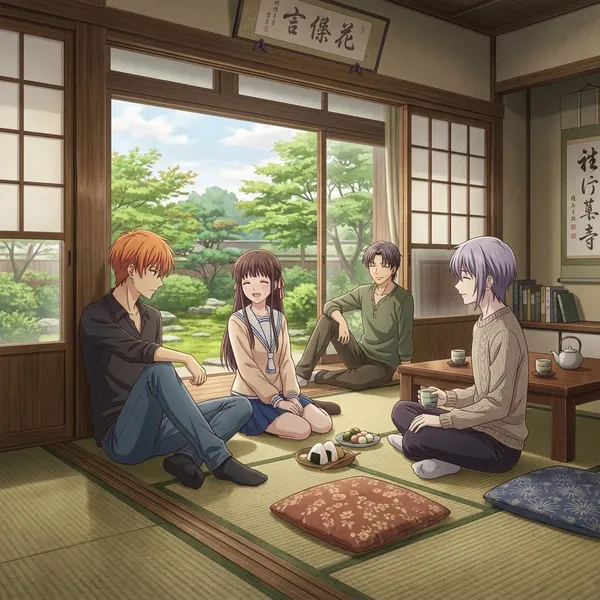
The 2019 adaptation is not built around spectacle, and that is the right choice. Its visual style, voice acting, and music are designed to support intimate emotional scenes rather than distract from them.
If you are choosing between versions, this is another reason to start with 2019. The newer adaptation has the complete story, a more consistent dramatic tone, and production choices that match the manga's later emotional weight.
Soft visuals suit the intimate tone
The soft character designs and gentle color palette fit a story about vulnerability, repression, and gradual healing. The show often relies on small facial changes, quiet pauses, and body language rather than flashy animation.
That softness also creates contrast. The surface can look warm and safe even when the emotional material underneath is heavy, which makes the darker family drama feel more unsettling.
Seasonal imagery reflects emotional change
Rain, snow, blossoms, summer light, and changing skies are not just pretty background details. They give the series a sense of time passing, which supports one of its central ideas: healing does not arrive all at once.
Voice performances strengthen vulnerable scenes
The voice performances carry a lot of the drama, especially in scenes built around hesitation, confession, or emotional collapse. Kyo's anger, Yuki's restraint, Tohru's fragile cheerfulness, and Akito's volatility need to feel distinct, and the cast usually makes those differences clear.
Both Japanese and English viewers have a reasonable path here. If you normally prefer subs, the Japanese performances are strong; if you watch dubs, the English version is also a solid option rather than a compromise.
Music gives major reunions and farewells more weight
The soundtrack uses gentle piano, strings, and reflective melodies to support the big emotional turns without overwhelming them. It may not be a show where every track demands replay outside the episode, but inside the story the music does exactly what it needs to do.
Reunions, apologies, and farewells often land harder because the score gives the scene room to breathe. That restraint matters in a series that already leans openly emotional.
Conclusion
The 2019 Fruits Basket anime is worth watching if you want a complete, character-driven drama with romance, family pain, and emotional healing at its center. Start with the 2019 version, be patient with the gentler early episodes, and skip it only if slow pacing or high-emotion melodrama usually turns you away; for the right viewer, its final payoff is more than strong enough to justify the time.