If you want a practical leviathan anime review, the answer is mostly positive: Leviathan is worth watching for its alternate-WWI setting, inventive machine-versus-beast warfare, and polished CG spectacle, but it works better as a fast adventure than as a fully developed political epic.
Why Leviathan's worldbuilding stands out
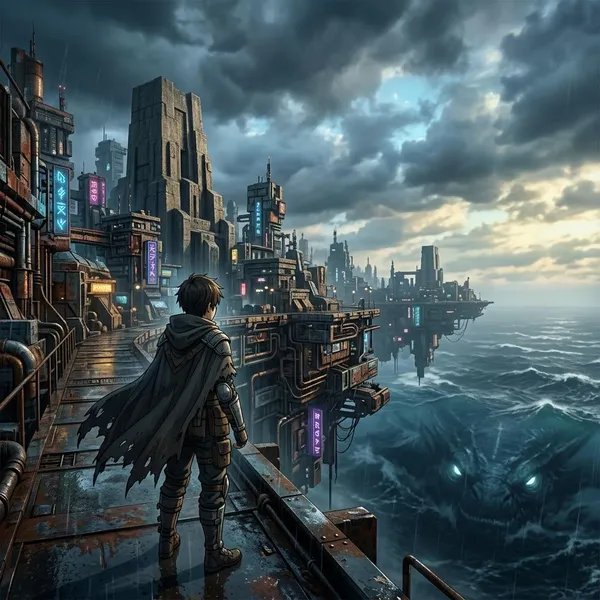
The first thing to check is whether the premise appeals to you. Leviathan imagines World War I as a conflict between industrial powers that build walking war machines and Darwinist nations that rely on engineered living creatures. That split gives the anime a stronger identity than many fantasy-war shows that only change the uniforms and country names.
Steampunk technology meets biopunk warfare
The Clanker and Darwinist divide is more than a visual hook. Clanker machines look heavy, loud, and deliberately engineered, while Darwinist Beasties feel flexible, strange, and alive. That contrast makes the war easy to read even when the politics move quickly.
For a casual viewer, this is the show's most immediate strength. You do not need a deep knowledge of the novels or World War I to understand the central conflict: one side believes progress comes from metal and control, while the other believes life itself can be designed into a weapon.
Alternate history reshapes World War I
Leviathan keeps enough real history to give the story weight, starting from the assassination that helps push Europe toward war. Then it bends that history into something stranger, replacing familiar military logic with dieselpunk walkers, living airships, and bio-engineered tools of empire.
Every country approaches war differently
The anime does not reduce the world to "machine people versus creature people" quite as much as it first appears. Different nations bring different motives into the conflict: survival, legitimacy, military dominance, revolution, and diplomacy all shape the route Alek and Deryn travel through.
- Anime-only viewers get enough context to follow the main stakes.
- Book readers may notice where political detail has been trimmed.
- Viewers who want dense strategy may find the world more promising than fully explored.
Machines and Beasties have distinct visual identities
The design language is one of the show's cleanest wins. Clanker machines tend to be angular, armored, and forceful; Beasties are curved, organic, and sometimes unsettlingly graceful. Even before a character explains what something does, the design usually tells you which side it belongs to and what kind of power it represents.
The globe-spanning journey keeps expanding the setting
Leviathan works best as a travel adventure. The characters keep moving through new regions, and each stop adds a slightly different pressure: military danger, political uncertainty, class tension, or a new piece of Darwinist or Clanker technology.
If you are watching for a slow, intimate war drama, that constant movement may feel too brisk. If you want a weekend binge with a strong sense of discovery, the format is a good fit because the setting rarely sits still long enough to become dull.
What Leviathan does well
The show's strongest parts are not only visual. Alek and Deryn give the story a human center, and their opposite positions make the war feel less abstract. He begins as a sheltered prince running from a political crisis; she is a capable Scottish girl hiding her identity so she can serve in the British Air Service.
Alek and Deryn provide contrasting perspectives
Alek and Deryn are not groundbreaking character types, but they are effective ones. Alek has to unlearn parts of his aristocratic upbringing, while Deryn has to stay sharp in a military world where one exposed secret could end her future. Their viewpoints let the anime discuss class, gender, loyalty, and nationalism without turning every scene into a lecture.
Their growing trust gives the story emotional weight
Their relationship is the emotional reason the adaptation still works despite the compression. The trust between them grows through danger, secrecy, and small choices rather than instant friendship. That makes the bond feel earned enough, even when some surrounding plot turns move faster than ideal.
The central adventure maintains a strong sense of discovery
The anime avoids one common worldbuilding problem: it does not just explain its setting from a distance. Alek and Deryn are constantly pushed into new places, new risks, and new alliances, so the audience learns by moving with them.
- Escapes keep the early episodes energetic.
- Travel expands the war beyond one battlefield.
- New technology keeps the setting visually fresh.
- Shifting loyalties stop the story from becoming a simple chase.
Political conflict adds depth beyond the action
The political layer gives Leviathan more texture than a simple "cool machines versus cool monsters" premise. Alek's identity matters because he is tied to dynastic power. Deryn's deception matters because her opportunities are limited by the rules around her. The war matters because every impressive invention is also part of a destructive system.
Joe Hisaishi's music strengthens the atmosphere
Joe Hisaishi's score gives the series warmth and scale without smothering it. The music is especially helpful in travel scenes and aerial sequences, where the show needs wonder, danger, and melancholy to exist at the same time.
It also softens some of the rushed adaptation edges. A few scenes that might otherwise feel purely functional gain a stronger sense of romance and distance because the score understands the story's old-world adventure mood.
How good is the CG animation?
The CG animation is one of the main reasons to try Leviathan. Studio Orange is well suited to this material because the world depends on scale, moving machinery, living creatures, and aerial geography. In those areas, the CG is not just acceptable; it often feels like the right choice.
The only real caution is character movement. If you strongly dislike CG anime faces and body acting, the first episode may take adjustment. If you are only mildly hesitant, give the show one full episode rather than judging from short clips, because the style works better in motion and context.
Mechanical designs feel detailed and convincing
The Clanker machines are where the CG immediately pays off. Walkers and armored vehicles have weight, depth, and a sense of mechanical resistance. When they turn, brace, or take damage, they feel built rather than merely drawn as background spectacle.
Engineered creatures move with real personality
The Beasties could have looked silly if the animation treated them like generic monsters. Instead, many of them have posture, rhythm, and small behavioral details that make them feel like living systems. The giant airship concept is strange, but the show commits to it strongly enough that it becomes part of the world's logic.
Aerial battles make effective use of three-dimensional space
The aerial scenes are among the production's highlights. The camera can track height, distance, and direction clearly, so the sky feels like an actual battlefield rather than a flat backdrop. You can usually tell where the danger is coming from and how the characters are moving through it.
That clarity makes the action more enjoyable than simple visual noise. The show understands that spectacle only works when the viewer can follow the space.
Environments create a convincing wartime journey
The changing environments help sell the scope of the war. Cities, mountains, airfields, interiors, and skies do not all blur into one generic CG setting. They give the journey a sense of distance, which is important because the story depends on travel as much as battle.
This is also where the anime can win over viewers who are unsure about the character models. Even if the human animation takes time to adjust to, the broader visual direction is confident and often beautiful.
Character animation may take time to adjust to
The human animation is polished, but it still looks like CG anime. Some facial expressions and movements may feel slightly less natural if your personal benchmark is high-end 2D animation.
- If you dislike all CG anime: this may still be a barrier.
- If you liked Beastars or Trigun Stampede: the style will probably feel familiar.
- If you are undecided: watch one full episode before making the call.
Where Leviathan falls short
Most of the anime's weaknesses come from the same source: it adapts too much story too quickly. Covering three novels in 12 episodes means some plot turns, political ideas, and supporting characters do not get the space they need.
Three novels are compressed into 12 episodes
This is the biggest drawback. The early episodes have enough room to establish the two leads and the basic conflict, but later developments arrive faster. Anime-only viewers can follow the story, yet there are moments where the connective tissue feels thin.
If you are deciding whether to watch or read first, this matters. The anime is the better choice if you want the visual concept and a quick version of the adventure. The books are likely the better route if you want slower character growth and fuller political context.
Some political conflicts develop too quickly
The anime raises interesting questions about power, peace, loyalty, and wartime ethics, but some of those ideas move more like plot checkpoints than fully developed conflicts. You understand what is happening, but not every decision lands with the weight it seems meant to carry.
Supporting characters receive limited attention
Several side characters have strong designs or clear dramatic purpose, yet the series rarely has enough time to let them breathe. This is most noticeable when a character is supposed to matter emotionally after only limited buildup.
Exposition slows parts of the journey
Oddly, the show can feel rushed and talky at the same time. Some scenes pause to explain politics, identity, or strategy because the adaptation needs viewers to keep up. Those explanations are useful, but a few feel more functional than dramatic.
- Patient viewers will probably accept the exposition as part of the worldbuilding.
- Action-first viewers may feel the momentum dip in dialogue-heavy stretches.
- Novel fans may notice where explanation replaces slower development.
The final stretch has less room to breathe
The ending delivers enough closure to make the season feel complete, but the final arc introduces big moral and political ideas without giving all of them time to settle. The spectacle is there, and the leads still matter, yet the deeper questions about peace and coercion could have hit harder with more episodes.
This is the point where your tolerance for compression matters most. If you mainly want a stylish adventure with a clear finish, the ending works. If you wanted the anime to fully unpack every political consequence, it may feel undercooked.
Conclusion
Leviathan is easiest to recommend to viewers who care more about imaginative worldbuilding, CG craft, and character-centered adventure than perfect pacing. Try it if steampunk walkers, living airships, and cross-faction trust sound exciting; skip or lower expectations if you need slow political development or cannot adjust to CG character animation.