For most people, the 1997 Berserk anime is still the one worth watching first. It is dated, incomplete, and rough in places, but it understands the character tragedy better than the newer adaptations. If you want a quick berserk anime review before choosing a version, start with 1997 unless old animation is a deal-breaker.
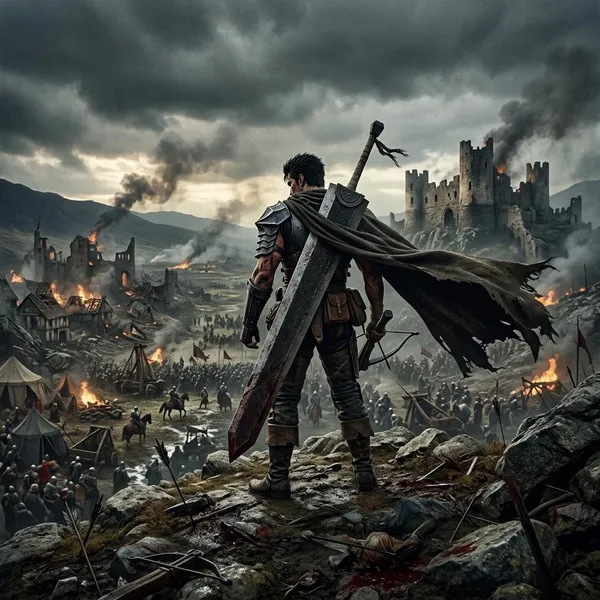
What Berserk is about
Berserk is a dark fantasy story about survival, ambition, loyalty, and the damage people cause when they turn a dream into something absolute. Its reputation for violence is real, but the reason it stays with people is the relationship between Guts, Griffith, and Casca.
Most anime versions focus on the Golden Age arc, which works like the emotional foundation for everything else. If you only watch Berserk for monsters and shock value, the story can seem simpler than it is. The stronger way to approach it is as a tragedy about people who need each other, misunderstand each other, and eventually break under the weight of their choices.
Guts fights his way through a brutal medieval world
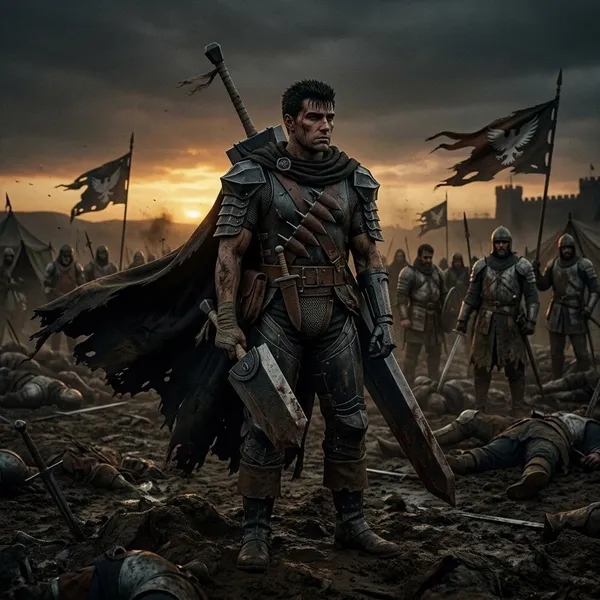
Guts looks like a simple lone swordsman at first, but his strength is mostly a survival response. He has learned to keep moving, keep fighting, and trust very little. That makes his quieter moments matter as much as his battles, because the real question is not whether he can swing a sword. It is whether he can live as something more than a weapon.
The medieval world around him is cruel without feeling clean or heroic. Mercenary life, class power, and constant war shape what people believe they are allowed to want. Guts is compelling because he is not protected from that world; he is built by it.
Griffith leads the ambitious Band of the Hawk
Griffith is the kind of leader people would follow into danger because he makes danger feel meaningful. He is brilliant, composed, and almost impossible to read, which is exactly why the Band of the Hawk gathers around him.
- For the soldiers, Griffith offers purpose and upward movement.
- For Guts, he becomes both a rival and a source of belonging.
- For the story, his dream creates the pressure that eventually exposes everyone's weakness.
Casca becomes central to their shared tragedy
Casca is not just caught between Guts and Griffith. She is one of the reasons their conflict feels human instead of symbolic. Her loyalty to Griffith, her resentment toward Guts, and her own need for dignity give the Golden Age arc much of its emotional tension.
When an adaptation handles Casca well, the tragedy lands harder because the cost is not abstract. You see how devotion can become identity, and how painful it is when that identity no longer protects you.
The Golden Age arc shapes everything that follows
The Golden Age arc is the part beginners should understand first. It shows how Guts joins the Band of the Hawk, why Griffith's dream becomes so powerful, and how Casca becomes tied to both men in different ways.
What Berserk 1997 does exceptionally well
The 1997 anime remains the strongest adaptation because it knows where Berserk's power actually sits. It does not have the smoothest animation or the most complete story, but it gives the central relationships enough room to breathe.
That matters for two kinds of viewers. If you are new to Berserk, 1997 makes the emotional stakes easy to understand. If you already know the manga, it works because it captures the mood rather than trying to race through plot points.
Guts, Griffith, and Casca receive strong development
This is the main reason to choose the 1997 version. Guts, Griffith, and Casca do not feel like pieces being moved toward famous scenes. Their relationships shift gradually through pride, admiration, frustration, dependence, and silence.
The Band of the Hawk also feels like a real group instead of background noise. That makes a practical difference: when the story turns darker, it hurts because the anime has already made the group feel worth losing.
Ambition and friendship drive the conflict
Berserk 1997 treats friendship as something powerful but unstable. Guts wants to stand beside Griffith as his own person, while Griffith seems unable to accept closeness that does not serve his dream. That imbalance is more interesting than a simple hero-versus-villain setup.
Quiet scenes give the tragedy emotional weight
Some of the best moments in 1997 are not battles. A pause after a conversation, a private look, or a character choosing not to say what they mean can carry more force than a larger action scene.
This slower rhythm may feel old-fashioned if you mainly watch modern seasonal anime. Give it a few episodes before judging it only by pacing. The patience is not filler; it is what makes the later collapse feel personal.
The soundtrack creates an unforgettable mood
Susumu Hirasawa's music gives Berserk 1997 a strange, lonely atmosphere that newer versions never fully replace. The soundtrack can make a victory feel haunted and a quiet scene feel like fate is already closing in.
The darker moments feel earned rather than excessive
Berserk is brutal, but the 1997 adaptation usually gives its darkness context. The harshest turns are not there simply to prove that the world is awful. They come after the anime has shown what the characters want and why those wants are dangerous.
That does not make the disturbing scenes easy to watch. It does make them feel less like random shock material and more like the consequence of ambition, loyalty, fear, and control pushed past the point of return.
Where Berserk 1997 falls short
The 1997 anime is the best starting point, but it is not the easiest one. Its biggest problems are visible right away: limited animation, missing manga material, and an ending that does not offer real closure.
Limited animation weakens some battles
The battles in Berserk 1997 are often carried by framing, music, and intensity rather than fluid movement. You will see still images, economical cuts, and action that suggests impact more than fully animates it.
That weakness matters most if you are watching for sword-fight spectacle. If you are watching for mood and character consequences, the action is usually serviceable enough, though rarely impressive by modern standards.
Important manga material is removed
The 1997 anime cuts or reduces parts of the manga, including world-building and material that gives later events more context. The adaptation stays focused, but the world can feel smaller than it should.
The story ends on an abrupt cliffhanger
The ending is memorable, but it is not satisfying in a normal sense. It stops at a point that leaves major emotional and story consequences unresolved.
If you like clean endings, know that before you begin. The 1997 anime works best when you treat it as the first step into Berserk, not as the full experience. Many viewers go directly to the manga afterward, and that is still the most sensible move.
Older production choices may deter new viewers
The age of the show is obvious in its editing, pacing, color palette, and performances. For some viewers, that gives it texture. For others, especially people used to sharper digital presentation, it can feel stiff at first.
Which Berserk adaptation should you watch first?
The safest recommendation is 1997 first, then the manga. Memorial Edition is the better backup if you want a faster, cleaner-looking version of the Golden Age arc. The 2016 adaptation should be treated as a curiosity, not the main way to continue the story.
| Viewer situation | Best choice | Why |
|---|---|---|
| You want the strongest character drama | Berserk 1997 | Best atmosphere and emotional buildup |
| Old animation is a major barrier | Golden Age Memorial Edition | Faster pace and more modern presentation |
| You want the complete story | Manga after an anime start | No anime covers everything properly |
| You only want later arcs animated | 2016/2017, with low expectations | It continues the plot but is weak visually |
Conclusion
Berserk 1997 is still the adaptation I would recommend first because it gets the part that matters most: the slow emotional ruin of Guts, Griffith, and Casca. Pick Memorial Edition if you need a smoother modern entry point, skip 2016 unless you are especially curious, and move to the manga when you want the story without the anime compromises.