Blood-C is worth watching if you like slow-burn horror, stylish sword fights, and a mystery that only pays off late; it is a poor fit if you need steady character development from the first few episodes. The most honest blood c anime review verdict is that the show is memorable, uneven, and much easier to appreciate when you know the slow start is part of the trap rather than simple filler.
What Blood-C is about
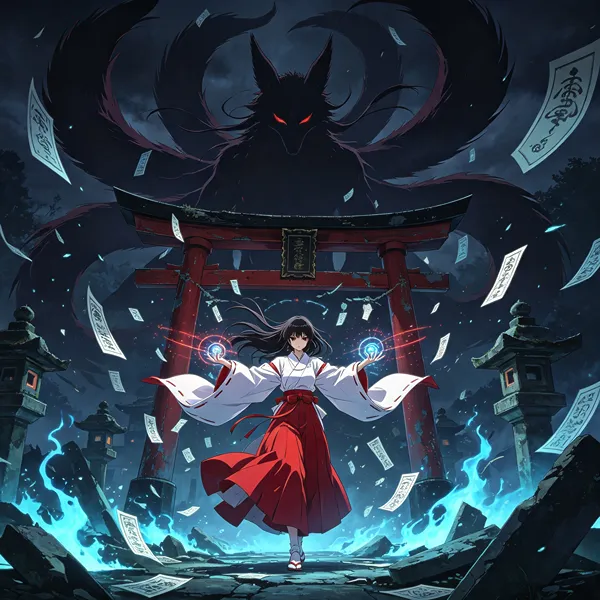
Blood-C follows Saya Kisaragi, a cheerful schoolgirl and shrine maiden whose quiet town life hides a violent duty. By night, she fights monsters known as Elder Bairns with a sacred sword. At first, that setup sounds like a straightforward supernatural action anime, but the real hook is the growing feeling that Saya's daily life has been arranged too neatly.
Saya Kisaragi lives as a student and shrine maiden
Saya begins as a gentle, clumsy, almost exaggeratedly innocent girl living with her father at a shrine. She goes to school, sings to herself, talks with classmates, and performs shrine duties. That softness is not just cute character dressing; it makes the violence around her feel more wrong.
She secretly fights creatures known as Elder Bairns
Saya's night battles are where the series shows its sharper side. The Elder Bairns are dangerous, strange, and visually varied enough that the fights do not all feel copied from the same template. They also keep reminding you that the town has rules Saya does not fully understand.
Her daily routine begins to feel increasingly unnatural
The repeated school days, shrine scenes, and monster attacks are the main patience test. On a casual weeknight watch, those early episodes may feel like the show is moving in circles. If you are watching closely, though, the repetition starts to feel staged: people react a little too neatly, conversations land a little too cleanly, and normal life begins to look less normal.
Questions about her identity drive the central mystery
Saya's identity is the part that decides whether the anime works for you. The show keeps hinting that her memories, relationships, and role in the town are not as simple as she believes. If that question grabs you, the slow build has purpose; if it does not, the early cast and episodic structure probably will not carry the series on their own.
What Blood-C does exceptionally well
Blood-C is not a balanced crowd-pleaser, but it has a strong identity. Its best qualities are visual contrast, clean action, unsettling calm, and a willingness to become genuinely nasty when the story finally breaks open.
Sword fights are fluid and visually striking
The sword fights are one of the safest reasons to recommend Blood-C. Saya's movements are sharp, readable, and elegant, with choreography that usually lets you follow the strike, dodge, and impact clearly. Even when an episode feels slow, the action scenes often have enough polish to stand out.
CLAMP character designs create a memorable contrast
CLAMP's character designs give the anime a graceful, polished look that clashes hard with the gore. Saya's glasses, school uniform, and shrine maiden appearance make her seem delicate at first glance, which makes the later brutality feel more disturbing than it would in a grim-looking show from the start.
Monster designs make each encounter distinct
The Elder Bairns are not just interchangeable targets. Some feel animal-like, some grotesque, and some almost ritualistic. That variety gives the monster-of-the-week structure more visual life, especially during the stretch where the plot itself is still holding back.
Quiet scenes build an uneasy atmosphere
The quiet scenes work best when you stop expecting them to behave like normal slice-of-life moments. A walk to school, a polite conversation, or a calm meal can feel too clean, as if everyone is playing a role. That unease is subtle, but it is one of the reasons the final episodes hit harder.
The final stretch delivers intense horror
The final stretch is where Blood-C fully earns its reputation. The violence becomes graphic, the psychological pressure rises, and the show stops hiding how cruel its setup can be. It is not gentle horror, and gore-sensitive viewers should know that before starting.
Where Blood-C falls short
The same choices that make Blood-C distinctive also make it easy to drop. It withholds too much for too long, repeats its early structure heavily, and gives many supporting characters limited emotional weight. The problem is not that the show is slow; it is that the slow parts do not always give enough reward while you are watching them.
Early episodes follow a repetitive structure
The early pattern is very noticeable: school life, shrine life, a strange hint, then an Elder Bairn fight. Horror can use repetition well, but here it sometimes becomes too easy to predict the episode rhythm before the mystery has enough force behind it.
Supporting characters receive limited development
Many side characters feel more like pieces in Saya's environment than fully rounded people. There is a story reason for some of that, but it still weakens the emotional impact. A reveal can explain flatness without making those characters more affecting in the moment.
Important answers arrive very late
Blood-C saves major answers for the endgame, which creates both its appeal and its biggest risk. Patient viewers may enjoy watching the clues gather slowly. Others may feel the show confuses withholding information with building suspense.
The issue is especially clear if you prefer mysteries that offer smaller payoffs along the way. Blood-C gives hints, but it does not always give enough partial answers to make every episode feel productive.
Emotional investment depends heavily on the central twist
The central twist does a lot of heavy lifting. If it lands for you, earlier scenes can suddenly look more deliberate and cruel. If it does not, the same scenes may feel like the show spent too much time delaying the real story.
The ending leaves part of the story for the sequel
The TV series reaches a major turning point, but it does not feel fully closed. If you want the direct continuation, Blood-C: The Last Dark is part of the experience rather than an optional extra. That is fine for completionist viewers, but frustrating if you prefer a 12-episode anime to stand completely on its own.
Why the second half changes the experience
The second half does not turn Blood-C into a different anime, but it makes the first half easier to understand. The routine begins to crack, the violence escalates, and the show becomes clearer about the kind of horror story it has been building.
This is why the series is hard to judge from only the opening episodes. The early part can feel almost passive, while the later part is aggressive and revealing. Whether that contrast feels clever or uneven depends on how much patience you have for delayed payoff.
Small inconsistencies begin to expose the mystery
As the episodes move forward, the little oddities become harder to ignore. Repeated phrases, awkward reactions, and strangely controlled behavior start to look like clues rather than weak writing. The viewing experience improves once you shift from waiting for action to watching for what does not fit.
The familiar school routine starts to collapse
The school routine becomes more effective once the viewer no longer trusts it. The same classrooms and casual exchanges that felt dull early on start to feel unstable. Instead of throwing away the repetitive setup, the anime uses it as something to damage.
Violence and psychological tension escalate quickly
When the escalation arrives, it is sudden and harsh. The gore is not just decoration; it breaks the controlled calm that the show spent so long establishing. Still, this is where a common mistake happens: expecting the shock alone to fix every pacing problem. It makes the series more memorable, but it will not make everyone forgive the slow build.
Major revelations reframe the earlier episodes
The late revelations are meant to make you reconsider Saya's relationships, the town's behavior, and the repeated daily structure. That reframe is the strongest argument for watching the series all the way through.
It works best for viewers who enjoy twist-driven stories where earlier scenes gain new meaning after the fact. If you need strong emotional attachment before the twist, the reveal may feel more clever than moving.
The payoff works best for patient viewers
Blood-C rewards a specific kind of patience: not patience for endless lore, but patience for atmosphere that feels slightly fake on purpose. A good checkpoint is the midpoint. If the unnatural routine, Saya's identity questions, and growing dread have started to bother you in an interesting way, the second half is likely worth finishing.
- Continue if: you are curious about the town, Saya's memories, or why everyone feels oddly placed.
- Drop it if: the repetition only feels boring and the horror style is not your taste.
- Be cautious if: graphic violence is a deal-breaker; the later episodes are far more intense than the early ones suggest.
How Blood-C fits into the Blood franchise
Blood-C is easy to start because it does not require previous Blood entries, but it is not necessarily the best representation of the whole franchise. It is more of a separate, stylized horror take on familiar ideas than a direct continuation of earlier stories.
Blood-C follows its own continuity
Blood-C uses familiar franchise elements, including a girl named Saya and supernatural bloodshed, but it follows its own continuity. You do not need to know the exact background of Blood: The Last Vampire or Blood+ to understand this version.
Blood+ and The Last Vampire are not required viewing
You can watch Blood-C without seeing Blood+ or Blood: The Last Vampire. The better question is what kind of experience you want. Choose Blood-C for stylized horror and a late twist; choose Blood+ if you want a longer, more character-driven story.
The Last Dark continues Blood-C directly
Blood-C: The Last Dark is the direct follow-up to the TV series. Watch the series first, then the movie. Starting with the film removes too much setup and makes Saya's situation less meaningful.
Blood+ offers a slower and more character-driven alternative
Blood+ is also slow, but its slowness usually serves character relationships and long-term emotional development. Blood-C is shorter, colder, and more focused on atmosphere, deception, and violent payoff.
If you are a casual horror viewer looking for one sharper, stranger experience, Blood-C may be the more memorable choice. If you want a fuller cast and steadier emotional attachment, Blood+ is the safer route.
Conclusion
Blood-C is worth watching when you are in the mood for a slow, suspicious horror anime that saves its strongest material for the end and does not mind being unpleasant. It is not the right pick for someone who wants quick momentum, warm character drama, or a clean standalone ending. Give it a fair midpoint check: if the artificial routine has started to feel eerie rather than dull, the final stretch is likely to justify the time.