If you want a quick frieren anime review, the answer is yes: Frieren: Beyond Journey's End is worth watching, especially if you like character-driven fantasy more than nonstop battles. The only real warning is the pacing. If you need an urgent plot hook in the first episode, give it a few episodes before deciding.
Why Frieren feels different from other fantasy anime
Frieren stands out because it is not built around the usual fantasy question of whether the heroes can defeat evil. That part has already happened. The Demon King is gone, the legendary party has returned home, and the real story begins when victory is no longer enough to explain what those years meant.
The story begins after the final battle
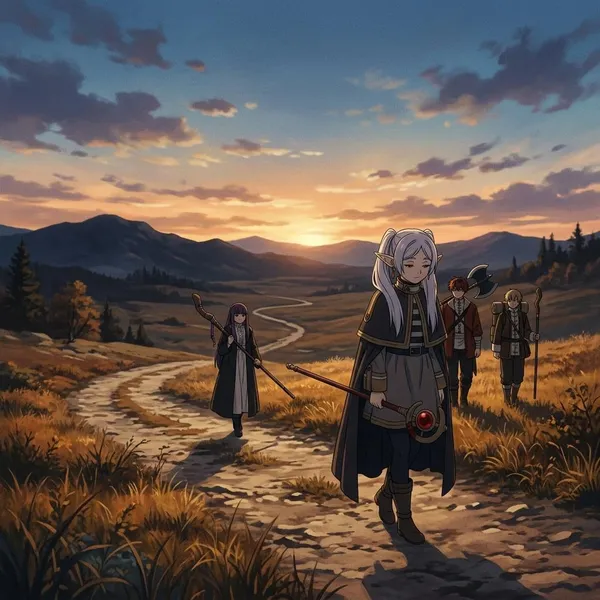
The opening is the hook. Frieren is an elf mage who helped save the world, but because she lives so much longer than humans, that ten-year journey felt brief to her. For her human companions, it was a defining part of their lives.
When she meets them again decades later, the difference finally catches up with her. Himmel has aged, and his death makes Frieren realize she never understood him as well as she could have. The series is not asking "Can the hero win?" It is asking "What did the hero fail to notice while everyone was still alive?"
Time changes every relationship
Time is not just background in Frieren; it is the pressure behind almost every relationship. A promise that feels minor to Frieren may last for decades in someone else's memory. A short trip for her may be a large part of another person's life.
This is where the show becomes more than a clever fantasy premise. It turns long life into an emotional blind spot. Frieren is powerful, experienced, and often calm in danger, but she has to learn that attention, presence, and timing matter as much as grand heroic acts.
Quiet moments carry real weight
The quiet scenes are not filler. Meals, small errands, village stops, awkward conversations, and old stories are where the anime does much of its best work.
- Patient viewers get a richer emotional payoff because the show lets bonds form slowly.
- Action-first viewers may need to adjust expectations during the early episodes.
- Slice-of-life fans may find the travel rhythm surprisingly comfortable.
Memories shape the present journey
Flashbacks matter because they change how Frieren sees the present. A statue, a spell, or a passing comment can turn into proof that Himmel understood something she missed years earlier.
That repeated re-evaluation gives the anime its melancholy edge. Frieren cannot change the past, but she can change how she treats Fern, Stark, and the people she meets now. That keeps the story from becoming only sad; regret becomes a reason to pay better attention.
Story and pacing
The pacing is deliberate rather than slow by accident. Frieren starts with reflection, moves into episodic travel, and later opens up into more structured fantasy arcs. The important thing is not whether the anime has action, but whether you are comfortable waiting for it.
A slow and reflective opening
The opening episodes focus on loss, distance, mentorship, and the strange loneliness of living longer than everyone else. That choice gives the anime its identity early. It is not trying to hide its pace or trick you into expecting a conventional adventure.
For a new viewer, the best test is the first few episodes rather than the first few minutes. The series needs a little time to show how memory, humor, and regret will work together. Once that tone clicks, the slower scenes feel intentional instead of empty.
Episodic travel with steady progress
The travel structure can look modest from episode to episode: the party visits towns, takes requests, meets strangers, and follows traces of the old hero's journey. But the progress is steady because each stop changes the way Frieren relates to people.
- The journey has a clear emotional reason: Frieren is trying to understand what she missed.
- The party dynamic keeps evolving: Fern and Stark slowly become more than companions on the road.
- The world expands naturally: magic, politics, and danger appear through travel instead of long exposition.
This format works best if you like gradual accumulation. The anime is not aimless, but it rarely hurries just to prove it has a plot.
Action used for greater impact
When Frieren uses action, it tends to matter. Battles are not placed there just to wake up the audience; they reveal skill, temperament, fear, discipline, and the rules of magic.
That restraint helps the fights feel sharper. Frieren's calm control, Fern's precision, and Stark's nervous courage all come through in combat. The action is exciting partly because the anime has already made you understand who is fighting and why the moment matters.
Faster momentum in later arcs
The later arcs bring more obvious fantasy structure, especially with stronger enemies and the First-Class Mage Exam material. Viewers who were waiting for tactics, expanded magic systems, and larger casts usually become more engaged here.
Characters and emotional growth
The characters are the main reason Frieren stays memorable after the pretty backgrounds and strong fights fade from mind. Their growth is not loud. It shows up in habits, timing, small acts of care, and the way old memories change new choices.
This is also where the anime avoids feeling like a standard party adventure. Frieren, Fern, Stark, and Himmel each bring a different kind of emotional weight, so the group dynamic has warmth without becoming overly sentimental.
Frieren learns to understand human lives
Frieren is compelling because her biggest flaw is not weakness or cruelty. She simply failed to understand how short human lives make ordinary moments precious.
That gives her arc a quiet maturity. She can be almost unbeatable in a fight and still be clumsy with grief, affection, and timing. Watching her become more attentive is the real progression system of the story.
Fern keeps the group grounded
Fern gives the journey structure. She notices routines, responsibilities, money, manners, and all the practical details Frieren might drift past. Without her, the anime would feel much more distant.
She also has emotional weight of her own. Her seriousness comes from loss and discipline, not from being written as the "responsible one"for easy jokes. That is why her deadpan humor works so well: it sits on top of a character who has already had to grow up carefully.
Stark brings warmth and courage
Stark adds the human messiness the group needs. He is scared, expressive, awkward, and often funny, but he still steps forward when it matters.
His courage feels better because it costs him something. For viewers who dislike flawless warrior characters, Stark is a good counterexample: brave enough to act, nervous enough to feel real.
Himmel remains the emotional anchor
Himmel is mostly present through memory, yet he shapes the whole anime. At first he can seem like the ideal hero from a storybook, but the flashbacks gradually make him more specific: kind, vain, perceptive, and far more emotionally aware than Frieren realized.
His importance is not only that Frieren misses him. It is that he shows what a short life can leave behind when someone uses their time with care. That contrast is the reason his absence keeps feeling active rather than decorative.
Animation music and voice acting
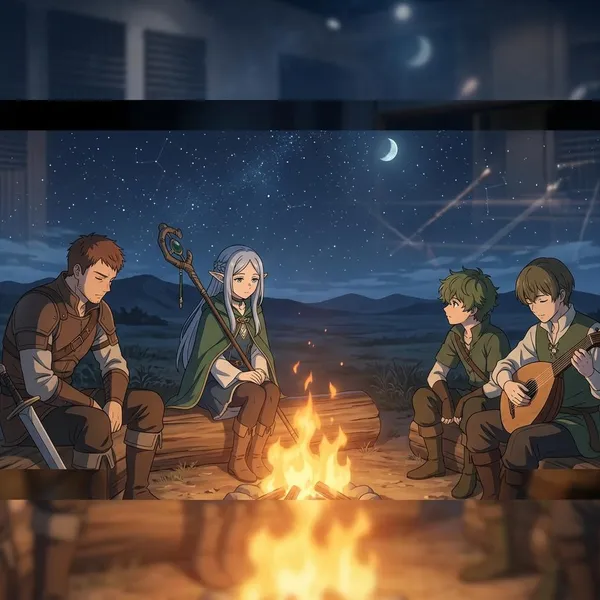
The adaptation is a major part of why Frieren became so widely praised. The source material was already strong, but the anime adds atmosphere, timing, music, and motion without flattening the story's restraint.
Detailed and consistent animation
The animation is strong not only during battles, but also in small character movement. A glance, a pause, a tired posture, or a slight change in expression can carry a scene.
The backgrounds help as well. Roads, towns, forests, and interiors feel calm and lived in, which suits a story about travel and memory. The show rarely looks like it is saving all its effort for one highlight episode.
Fluid action without visual clutter
The magic fights are easy to read, which is more important than it may sound. You can usually understand the threat, the response, and the tactical difference between characters without being buried under effects.
- Frieren's fights feel controlled and ancient rather than flashy for the sake of it.
- Fern's action scenes emphasize discipline and clean execution.
- Stark's moments work because fear and courage appear together.
Music that strengthens quiet scenes
The music is one of the anime's strongest emotional tools. It supports scenes instead of forcing them, which fits a story where many feelings are half-spoken.
Subtle and natural voice performances
The voice acting stays controlled, which is exactly what the material needs. Overplayed emotion would make Frieren's restraint feel artificial.
Frieren's performance carries distance, dry humor, and small emotional shifts without making her sound empty. Fern and Stark also benefit from that natural approach: their conversations feel lived in, not like characters taking turns delivering theme statements.
Frieren anime vs manga
The anime and manga are both worth experiencing, but they serve slightly different needs. The anime is the better first choice for most people because the music, voices, color, and pacing make the emotional atmosphere easier to feel immediately.
The manga is better if you already know you like the story and want to move faster. It also works well for readers who prefer a quieter, more self-paced version of the same material.
The anime expands key action scenes
The anime adds real value in action-heavy moments. Some fights that are brief on the page become more memorable in motion because the adaptation gives them timing, weight, and clearer tactical flow.
This does not make the anime less faithful. It understands where animation can strengthen the manga instead of simply copying it. If you care about spectacle, the anime is easily the stronger version for those scenes.
The manga offers a quicker reading pace
The manga is the practical option if you want to continue beyond the anime or move through slower travel sections at your own speed. Its clean style also suits the story's understated tone.
- Start with the anime if you want the most emotional first experience.
- Start with the manga if you prefer faster pacing and quiet reading.
- Use both if the premise already appeals to you; they complement each other well.
Conclusion
Frieren: Beyond Journey's End earns its reputation because it knows exactly what kind of fantasy it wants to be: patient, reflective, funny in small ways, and quietly devastating when it needs to be. It is not the best pick for someone who only wants constant action, but for viewers who enjoy emotional character growth and a story that treats time seriously, it is one of the easiest anime recommendations to make.