If you are looking up the interspecies reviewers anime, the main thing to know is that it is not a normal fantasy adventure with a spicy side joke. It is an adult comedy about characters rating fantasy brothels, and the controversy around it came from how far some versions pushed that premise. Before watching, the most useful checks are simple: which version you are seeing, how much explicit comedy you are comfortable with, and whether you want episodic jokes rather than a serious plot.
Interspecies Reviewers plot
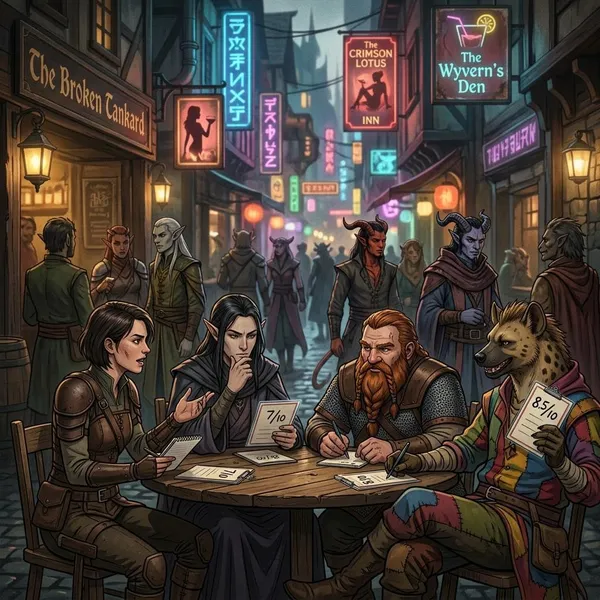
Interspecies Reviewers follows a group of adventurers in a fantasy world where different species run adult establishments. Instead of fighting through a grand quest, the characters visit those places, compare experiences, and publish reviews as if they are judging restaurants or inns.
That setup is deliberately crude, but it also gives the series a clear comic engine. The joke is not only that the subject is sexual; it is that the characters treat personal taste, species biology, and attraction like serious review criteria.
Stunk and Zel review fantasy establishments
Stunk and Zel are the core reviewing pair. They visit fantasy brothels, score their experiences, and argue over those scores with the confidence of professional critics. Their reviews are the show's main structure, so each new location becomes both a gag and a small test of how this world works.
Their difference matters more than the ratings themselves. Stunk judges from a human point of view, while Zel's elven standards make him value different traits, especially when age, beauty, and species lifespan come up. If you are expecting a normal buddy-adventure dynamic, their "conflict" is mostly taste-based rather than heroic.
Crim joins their unusual adventures
Crimvael, usually called Crim, changes the tone once joining Stunk and Zel. Crim often reacts with embarrassment or confusion, which gives the show a softer counterpoint to the two more shameless reviewers.
Crim also makes the series harder to describe in a clean category. The character's angelic nature and unusual identity let the anime push jokes into stranger territory, so viewers who are only mildly curious should treat Crim's arrival as a sign that the show becomes more provocative, not less.
Species differences shape every review
The fantasy races are not just decorative character designs. Lifespan, body type, senses, customs, magic, and social expectations all affect how the reviewers judge each place.
- Elves and humans disagree because age and maturity do not mean the same thing to them.
- Monster-girl and demi-human species create jokes around physical traits and compatibility.
- Angelic or magical beings let the show bend ordinary categories even further.
This is where the anime has more internal logic than its reputation suggests. The worldbuilding exists mainly to support dirty jokes, but it is still doing a job: it makes every review depend on who is doing the reviewing.
Personal preferences drive the comedy
The funniest part of the format is often the argument after the visit. One character may give a glowing score while another thinks the same experience was terrible, and both will defend that opinion as if it is objective truth.
That makes the show a parody of review culture as much as a fantasy sex comedy. The ratings are ridiculous, but the behavior is familiar: people argue about restaurants, games, hotels, and anime in the same overconfident way. If that kind of mock-serious debate sounds funny to you, the premise will probably make more sense than if you are only looking for plot progression.
Episodic visits replace a traditional quest
The series is highly episodic. A typical episode introduces a new establishment or species, lets the characters experience the gimmick, then ends with ratings and disagreement. There is continuity through the cast and tavern setting, but there is no big villain or dramatic mission driving the anime forward.
That matters for deciding whether to watch it. Someone sampling one episode out of curiosity can understand the formula quickly. A viewer who wants emotional arcs, serious fantasy lore, or a story that builds toward a finale may find the repetition tiring.
Interspecies Reviewers characters
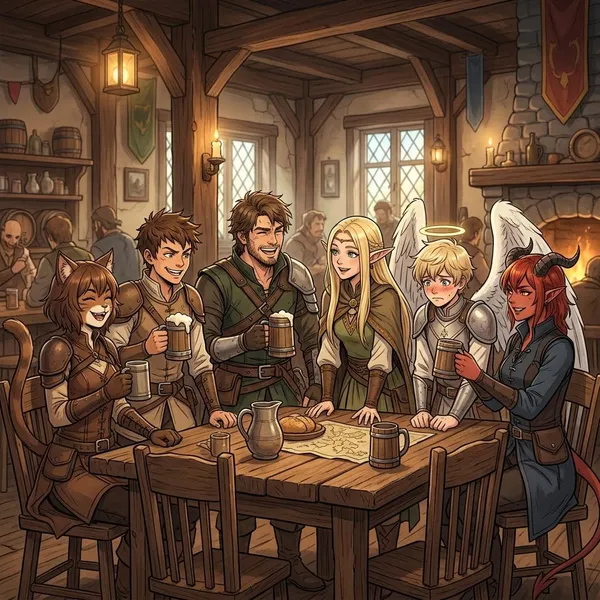
The main cast works because each character brings a different kind of bias to the reviews. The anime does not need a huge party of heroes; it needs people who can look at the same situation and reach completely different conclusions.
Stunk
Stunk is blunt, confident, and usually the first to say exactly what he thinks. As the human lead, he anchors many of the reviews in a more familiar point of view, even when his behavior is anything but restrained.
He is not written as a noble fantasy hero. His purpose is to push conversations forward, make shameless judgments, and treat the review process like it genuinely matters. If you dislike crude main characters, Stunk may be the first barrier to enjoying the show.
Zel
Zel works best as Stunk's opposite. Because he is an elf, his standards are shaped by a much longer lifespan and a different view of age and attraction. The show repeatedly uses that gap to turn a simple score into a species-based argument.
He can sound more analytical than Stunk, which makes the joke sharper. Zel is not really the sensible one; he is just ridiculous in a more composed way.
Crimvael
Crimvael is the character most likely to split viewer reactions. Crim brings innocence, awkwardness, and a less predictable identity into a group that otherwise knows exactly what it is doing. For some viewers, that contrast makes the comedy funnier; for others, it pushes the show into territory they would rather avoid.
Kanchal
Kanchal is a supporting character who helps the world feel social rather than isolated around Stunk and Zel. His presence suggests that recommendations, gossip, and reputation matter in this setting, which fits a story built around public reviews.
- He broadens the group dynamic without taking over the show.
- He reinforces the tavern-and-rumor structure that sends the leads toward new places.
- He helps break up the main trio's rhythm when the same review formula could become too mechanical.
Meidri
Meidri is the tavern waitress who gives the series a recurring home base. She often reacts with irritation or disbelief, which is useful because the main reviewers are usually too committed to their own nonsense to step back from it.
The tavern scenes also keep the episodic format from feeling completely disconnected. For a casual viewer, Meidri's role is easy to overlook, but she helps reset the comedy between visits and gives the cast somewhere familiar to return.
Censorship and versions
The version you watch can seriously change your impression of Interspecies Reviewers. A heavily censored TV cut may look like an extreme ecchi comedy with obvious visual blocks, while a less restricted version can feel much closer to adult material that mainstream platforms are not comfortable carrying.
So the practical viewing order is: check the release version first, then check your tolerance for explicit comedy. A curious anime fan watching for the controversy may want context before starting; someone watching with roommates, family nearby, or shared streaming history should be much more cautious.
Television versions used visual censorship
Some television broadcasts used heavy visual censorship, including bright light, steam, shadows, glare, and framing that hid explicit details. This was not just an occasional edit. Because the premise itself revolves around adult establishments, the censorship could become a constant part of the viewing experience.
For viewers, that creates a strange tradeoff: the TV version may be less revealing, but it can also feel more awkward because the edits are so obvious. If you mainly want to understand the story and controversy without seeing the most explicit cut, a censored version may be enough.
AT-X aired an uncensored version
AT-X aired a less restricted version, and that became one of the major reasons the anime gained attention outside its normal audience. People comparing versions could have very different reactions to what was supposedly the same episode.
This is also why arguments about how explicit the anime is can sound inconsistent. One person may be describing a blocked-out TV broadcast, while another is talking about the AT-X presentation. Both may be honest; they simply did not watch the same cut.
Home video restored additional material
Home video releases restored additional material and removed more of the broadcast censorship, which made them important for fans looking for the fullest version. That is common with adult-leaning anime, but it mattered more here because the series was already famous for testing broadcast limits.
Dialogue was altered in some broadcasts
Some broadcasts or local versions also softened dialogue. That matters because the series depends heavily on blunt banter, ratings, and direct comments; when the wording is toned down, the joke can land differently even if the scene structure remains the same.
- Visual edits change how much the viewer sees.
- Dialogue edits change how sharp or crude the joke feels.
- Platform removal changed the show's reputation from niche adult comedy to anime controversy.
The Funimation removal is best understood in that context. The show appears to have been more explicit in practice than the platform wanted to carry, especially once the actual content and version differences became clearer.

Conclusion
Interspecies Reviewers is worth understanding before watching because the premise, format, and version differences matter more than usual. If you want a raunchy episodic fantasy parody with review-culture jokes, it has a very specific appeal; if you want a plot-heavy adventure or only mild ecchi comedy, it is probably the wrong pick. The safest first step is to check which cut you are about to watch, because that can change the experience more than any summary of the plot.