One Piece is worth watching if you want a long adventure where the characters, world, and emotional payoffs matter more than speed. It is not the best pick if you mainly like tight 12-episode seasons, but for viewers who enjoy found-family stories and slow-burn mysteries, a one piece anime review usually ends with a strong recommendation: try it, but give it a fair runway before deciding.
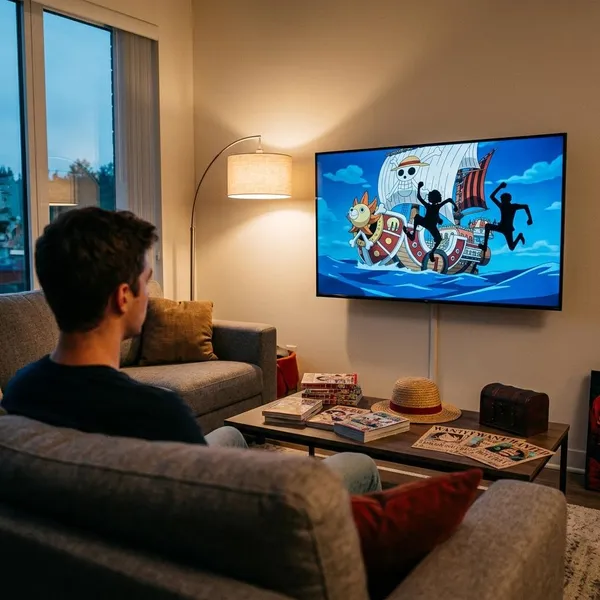
Why the story works over such a long run
The main reason One Piece survives its huge episode count is that its length has a purpose. The anime is not only stretching a pirate adventure across hundreds of episodes; it is letting friendships, promises, mysteries, and consequences build until later moments feel earned.
- For character attachment: the long runtime is a strength.
- For fast plot movement: the anime can feel slow, especially compared with the manga.
- For world-building: the gradual reveals are one of its biggest rewards.
Luffy gives the journey a clear purpose
Luffy keeps the story easy to follow even when the world becomes complicated. His goal is simple: become King of the Pirates and find the One Piece. That clear ambition gives the anime a steady direction while the islands, factions, and conflicts keep changing around him.
What makes him work is that he is not written as a polished hero. He is childish, stubborn, funny, and sometimes reckless, but when someone's freedom is being crushed, his response is immediate and emotionally clear. That directness gives the series its moral center without turning every conflict into a speech.
Each Straw Hat has a personal dream
The crew matters because they are not just Luffy's support team. Zoro, Nami, Usopp, Sanji, Chopper, Robin, Franky, Brook, and later members all have their own reasons for being on the ship, and the anime gives those dreams enough space to feel personal.
Side characters return in meaningful ways
One Piece has an unusually good memory. Characters who seem tied to one island can return later with new roles, changed circumstances, or unfinished emotional business. That makes the world feel active after the Straw Hats sail away.
Earlier mysteries shape much later events
The series is especially rewarding if you like unanswered questions that slowly gain weight. Ideas such as the Void Century, the Will of D., Poneglyphs, Ancient Weapons, and the structure of world power are not just background decoration; they gradually change how earlier events feel.
The scale grows without losing its emotional core
The story eventually reaches wars, secret history, government corruption, and world-shaking revelations, but its strongest scenes are still usually built around one person's pain or one promise the crew refuses to abandon. That is the balance that keeps the scale from becoming empty.
When does One Piece start getting good?
One Piece is charming from the beginning, but it does not show its full strength immediately. The safest test is not "watch three episodes and decide." A fairer checkpoint is Arlong Park, with Alabasta and Water 7 showing increasingly stronger versions of what the series can do.
East Blue establishes the crew
East Blue is foundation more than proof of the anime's full ambition. It introduces the early crew, the humor, the strange character designs, and the island-to-island rhythm. Some episodes feel simple by modern standards, but they teach you how the series wants to be watched: with attention to dreams, loyalty, and emotional turning points.
If you are a newer anime fan used to sleek modern productions, this stretch may feel old-fashioned. That does not mean it is pointless. Later arcs rely heavily on the attachment built here, so skipping too aggressively can make future payoffs feel weaker.
Arlong Park reveals the emotional depth
Arlong Park is the first major "now I get it" point for many viewers. The conflict is personal, the villain pressure is clear, and the crew's loyalty becomes more than a fun group dynamic.
This is a strong checkpoint for undecided viewers. If Arlong Park does nothing for you emotionally, the anime may not match your taste. If it hits, the longer journey becomes much easier to commit to.
Alabasta expands the larger conflict
Alabasta makes the world feel bigger. The Straw Hats are no longer only solving small island problems; they are pulled into a national crisis involving fear, manipulation, and political consequences.
For someone who likes adventure but wants more than one-villain-per-location storytelling, this arc is important. It shows that One Piece can connect personal loyalty with larger social stakes without losing the sense of travel.
Water 7 strengthens the character drama
Water 7 is one of the best arguments for watching a long story instead of only reading a summary. By this point, the crew has enough history that internal conflict can hurt as much as any external threat.
The drama works because it grows out of trust, insecurity, pride, and the fear of being left behind. If a viewer reaches Water 7 and still feels no attachment to the Straw Hats, that is a useful sign: the series may simply be too slow or too emotionally broad for their preferences.
Later arcs reward long-term investment
Later arcs are where the series pays back patient viewers. Old symbols, side characters, mysteries, and emotional wounds can return with much more force because the audience has lived with them for so long.
How the animation changes over time
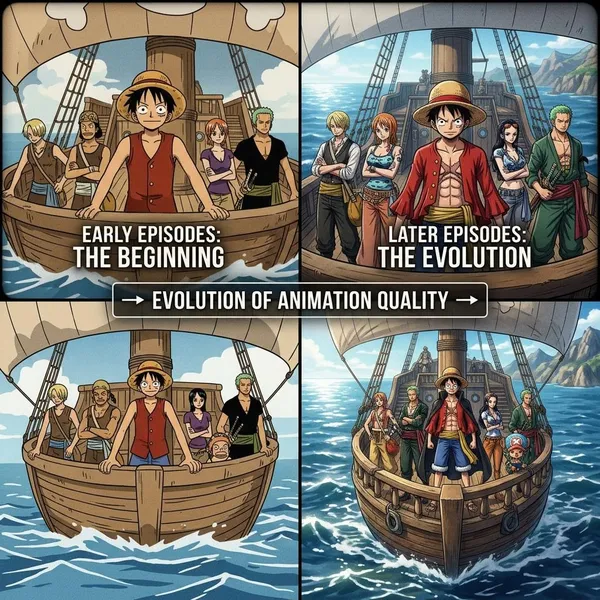
The animation changes a lot, but not in a straight line from "bad" to "good." One Piece began as a weekly TV anime in 1999, so older visuals, limited movement, and uneven production are part of the experience. The trade-off is that the anime becomes much more visually ambitious in later eras, especially during major fights.
Early episodes have a simple older style
The earliest episodes use cleaner lines, brighter colors, and simpler movement. They will not look like a current high-budget action anime, but the style fits the goofy, exaggerated world better than many people expect.
Major battles receive stronger production
The anime usually saves extra energy for moments that matter: big fights, emotional declarations, dramatic entrances, and arc climaxes. Even when regular episodes look modest, the key scenes often get stronger framing, timing, and impact.
That matters because fights in One Piece are rarely only about who is stronger. A good battle usually represents a promise, a wound, or a moral line Luffy refuses to ignore. Better production makes those turning points more memorable.
Character animation remains highly expressive
Expressiveness is one of the anime's most reliable visual strengths. Faces stretch, bodies exaggerate, reactions get huge, and the cast rarely feels emotionally flat even when the animation is technically limited.
This is especially important for comedy. A more realistic style would not sell Luffy's absurdity, Usopp's panic, Nami's rage, or Sanji's melodrama nearly as well. The designs are strange, but they are built to perform.
Modern arcs deliver more cinematic action
Modern One Piece can look dramatically more polished, with stronger lighting, effects, compositing, and action direction. Some recent episodes are visually impressive enough that people discover the series through clips before they know much about the story.
Weekly production still creates inconsistencies
The anime's biggest technical issue is still weekly pacing. Because it has run for so long while adapting an ongoing manga, some episodes stretch scenes with long pauses, repeated reactions, flashbacks, or slow movement through material.
| If this bothers you most | Better choice |
|---|---|
| Slow episode pacing | Read the manga |
| Old early visuals | Try the live-action first, then return |
| Missing music and voice acting | Stay with the anime |
| Wanting only the major story beats | Use arc checkpoints instead of forcing a blind binge |
Who will enjoy One Piece most?
One Piece is best for viewers who like settling into a world and growing attached over time. It is less ideal for someone who wants every episode to move the plot sharply forward. The real choice is not whether the series is "good" in the abstract, but whether its strengths match the way you like to watch anime.
Fans of large adventure stories
Viewers who enjoy exploration will probably understand the appeal quickly. The Grand Line keeps introducing islands with different rules, cultures, dangers, and visual identities, so the story rarely feels trapped in one setting.
The adventure works best when you enjoy the feeling of travel itself. Not every stop is equally strong, but the promise of the next island gives the anime a sense of forward motion even when the pacing slows.
Viewers who love found-family characters
The Straw Hats are one of the strongest found-family casts in anime because their bond is built through action, not just speeches. They argue, joke, rescue each other, challenge each other, and slowly become a home for people who once had very little of one.
If your favorite shows are driven by group chemistry, this is one of the clearest reasons to watch. Even quieter scenes can be satisfying because the crew dynamic is part of the reward, not filler between fights.
Audiences who value lore and world-building
Lore-focused viewers get a lot to chew on. The world has geography, history, political systems, pirate crews, military power, ancient mysteries, and inherited ideals that gradually connect across arcs.
The key is patience. One Piece does not explain everything as soon as it appears. It lets questions sit, then returns to them when the emotional or political context is stronger. That makes the world feel planned rather than decorative.
Patient viewers who enjoy gradual payoffs
This is the ideal audience for One Piece. The series often rewards the viewer who remembers a promise, a symbol, a side character, or a throwaway-looking detail from much earlier.
Less suited to fans of fast seasonal anime
If you mostly watch modern seasonal anime with tight arcs and constant momentum, the One Piece anime may test your patience. The humor can be loud, the pacing can drag, and the tonal shifts from absurd comedy to serious trauma are not for everyone.
Conclusion
One Piece is an easy recommendation for patient viewers who want a huge adventure with real emotional weight, but it is not a perfect fit for everyone. Start with the anime if you want the voices, music, and big emotional scenes in motion; choose the manga if pacing matters more; use the live-action version if you want a low-pressure first taste. The series works best when you stop treating the episode count as a challenge to defeat and start treating the journey as the point.