If you are looking for a straight sakamoto days anime review, the answer is yes, it is worth watching—but not because it is the strongest possible version of the story. The anime works best as an easy, charming action-comedy with a great central idea and a cast that is fun to spend time with. If you mainly care about fight impact, the manga is still the safer pick.
What works best in the Sakamoto Days anime
The anime's biggest strength is how quickly it sells the premise: a legendary hitman retires, becomes a family man, and now has to protect a peaceful life from the violence he left behind. That contrast gives the show a clear identity before the plot becomes complicated.
For a casual viewer, this is the kind of series that is easy to try for a few episodes. You do not need to study a power system or remember a huge cast right away. The first thing to check is simple: do you enjoy the mix of deadpan comedy, domestic warmth, and sudden assassin chaos? If that combination works for you, the anime has enough charm to keep going.
Sakamoto's calm adult charm
Sakamoto is refreshing because he is not another loud young hero trying to prove himself. He already has a past, a family, and a clear reason to avoid violence when he can. His calmness makes the comedy sharper: the joke is not only that he looks like an ordinary shop owner, but that he still carries terrifying skill under a completely domestic routine.
That adult energy also gives the show a different feel from many action anime. If you like leads who solve problems with quiet confidence instead of constant speeches, Sakamoto is easily the strongest reason to watch.
Warm chemistry across the main cast
The cast keeps the anime comfortable even when the action is not at its best. Shin adds nervous energy and emotional reactions, while Sakamoto stays steady and unreadable. Aoi and the family side give the story its emotional anchor, so the "retired hitman" idea feels like more than a repeated gag.
- Anime-only viewers may connect first with the voices and timing.
- Manga readers may enjoy seeing familiar interactions performed, even if the fights feel softer.
- Casual comedy fans get enough character warmth to stay interested between action scenes.
Comedy that keeps the story moving
The comedy works because it comes from contrast. A dangerous assassin situation might collide with shopping, store work, parenting, or some other ordinary problem. The humor usually supports the story instead of stopping it.
This matters if you are choosing something to watch after work or school. Sakamoto Days is not emotionally heavy every minute, and it does not rely only on loud reactions. The lighter rhythm makes it a good casual watch, especially if you want action without constant intensity.
Inventive fights in everyday settings
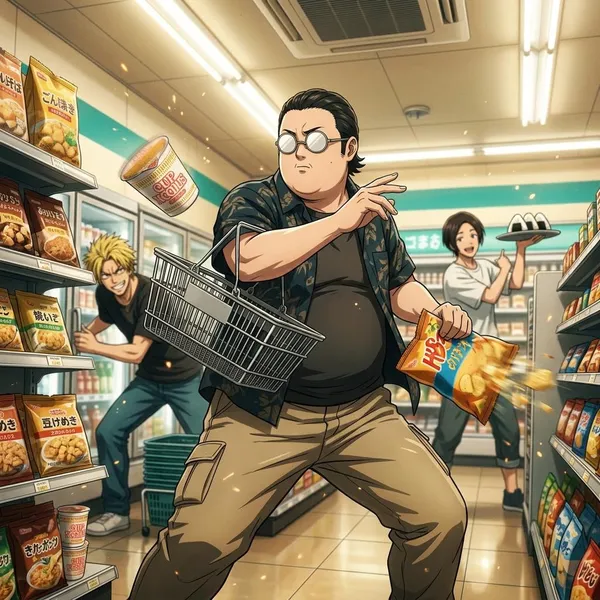
The best fights use normal places well. Stores, streets, public spaces, and random objects can become part of the choreography, which gives the action a fun practical edge. Sakamoto does not need a complicated supernatural explanation to be entertaining; the appeal is watching ridiculous skill applied to ordinary surroundings.
Where the anime falls short
The main problem is not the story. It is the adaptation's visual ceiling. The anime often communicates what is happening clearly, but clarity is not the same as impact. For a series built around a legendary assassin, some scenes should hit harder than they do.
Action that lacks visual weight
The action can be readable without feeling powerful. You may understand the punch, dodge, or counter, but not always feel the speed or danger behind it. That is where the anime loses some of the thrill that the premise seems to promise.
This becomes more noticeable during moments meant to prove how overwhelming Sakamoto is. If the animation does not give the movement enough force, his strength makes sense in the story but feels less exciting on screen.
Pacing that weakens key moments
Some scenes arrive before they have enough tension behind them, while others do not linger long enough to make an emotional or action beat land. The pacing is not disastrous, but it can make important moments feel smaller than they should.
For viewers who mostly want jokes and character chemistry, this may only be a mild issue. For viewers waiting for big set pieces, the uneven rhythm can be frustrating because the setup is often better than the payoff.
Limited movement in some scenes
There are scenes where the anime feels more cautious than stylish. Instead of sustained fluid motion, it sometimes relies on simpler cuts or brief bursts of action. That choice is easier to forgive in quiet scenes, but it stands out in a series whose reputation is tied to creative fights.
- Not a deal-breaker: if you mainly want a fun introduction to the cast.
- A real drawback: if animation quality is your first priority in action shows.
- Most noticeable: when a fight has a clever idea but not enough motion to sell it.
Less intensity than the manga
The manga generally feels sharper and more aggressive. Its paneling can make motion look fast, heavy, and stylish even without actual animation. The anime follows the same basic material, but it does not always recreate that rush.
This is the biggest divide between new viewers and existing fans. Anime-only viewers may see a likable action-comedy with some uneven production choices. Manga readers are more likely to compare specific scenes and feel that the adaptation softened the impact.
Sakamoto Days anime vs manga
The anime and manga are not competing in exactly the same way. The anime gives you voices, music, color, and a low-effort entry point. The manga gives you stronger visual direction and more convincing fight energy. The best choice depends on what you want first.
| Choose this version first | If your priority is |
|---|---|
| Anime | Easy access, cast chemistry, comedy timing, and a quick test of the premise |
| Manga | Sharper action, stronger visual impact, and the most energetic version of the fights |
| Both | Enjoying the performances while still getting the manga's stronger action presentation |
The anime adds strong voices and music
Voice acting gives the comedy better timing, especially when the scene depends on deadpan reactions or sudden tonal shifts. Music also helps separate the warm family moments from the dangerous assassin side of the story.
Sound cannot fix every visual limitation, but it does make the anime feel more inviting. If you value mood and performance as much as choreography, the adaptation still has a clear reason to exist.
The anime offers an easier entry point
The anime is the simpler starting point for most people. You can test the tone quickly, understand the setup within minutes, and decide whether the cast works for you without buying or reading several volumes.
This is especially true if you are recommending the series to someone who does not usually read manga. "Retired hitman runs a family store while old enemies return" is an easy pitch, and the anime lets someone sample that hook with very little commitment.
The manga delivers sharper artwork
The manga is the better format if you care most about how the action looks. The page layouts, poses, and impact shots often give fights more confidence than the anime manages. Even still panels can feel more dynamic because the composition is so deliberate.
The manga gives fights more energy
The manga usually makes attacks feel faster, counters feel smarter, and impacts feel heavier. That difference changes the whole impression of the series. A scene that feels merely fine in the anime may feel much more exciting on the page.
Conclusion
The Sakamoto Days anime is worth watching if you want a likable action-comedy with a calm adult lead, warm cast chemistry, and a funny domestic twist on the hitman genre. It is less easy to recommend as the definitive version for action fans, because the manga gives the fights more force and style. Try the anime for the characters and tone; read the manga if the concept clicks but the action leaves you wanting more.