Solo Leveling is worth watching if you want a sharp, fast-moving power fantasy with excellent action and a clear sense of progression. This solo leveling anime review has one main caveat: the show is much stronger as a stylish action ride than as a deep character drama.
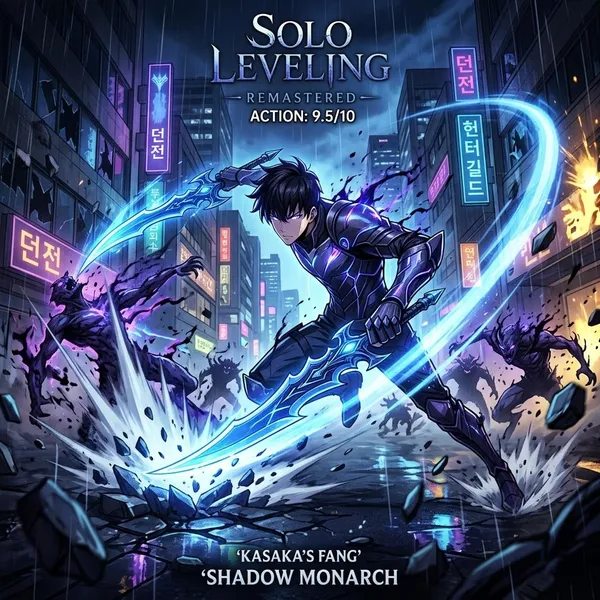
What is Solo Leveling about?
Solo Leveling takes place in a modern world where supernatural gates open and lead to monster-filled dungeons. Hunters with special abilities enter those gates to clear them before the danger spills into ordinary life.
At the center is Sung Jinwoo, a low-ranked hunter who keeps risking his life because his family depends on him. After one brutal raid changes everything, he gains access to a strange system that lets him grow stronger in a way no other hunter can.
Jinwoo starts as the weakest hunter
Jinwoo's weak starting point is one of the best things about the early episodes. He is not a hidden genius waiting for praise; he is an E-rank hunter who can barely survive jobs that stronger hunters treat as routine.
That matters because the danger feels personal. In the opening stretch, a dungeon is not just a cool setting for a fight. It feels like a place where one wrong move could kill him, which gives his later growth a stronger payoff.
A hidden system lets him grow stronger
The system is the hook that turns the show from a dark dungeon story into an addictive progression fantasy. Jinwoo receives quests, stat gains, rewards, and penalties in a structure that feels close to an RPG.
- Clear growth: his improvement is visible, not just announced.
- Immediate payoff: training and danger usually lead to a noticeable upgrade.
- Built-in mystery: the system helps him, but its real purpose is not obvious at first.
Gates and dungeons threaten the human world
The gate setup keeps the story easy to follow. A portal appears, hunters enter, monsters wait inside, and failure can put civilians at risk. The rules are simple, which lets the anime move quickly without long explanations.
It also gives the show room to change tone. One dungeon can feel like survival horror, another like a boss raid, and a later one like a public disaster. That variety helps the repeated dungeon structure avoid feeling too mechanical.
Why the action works so well
The action is the main reason Solo Leveling is so easy to recommend. It is fast, readable, and built around escalation rather than random noise. You usually understand who has the advantage, when the balance changes, and why a finishing move matters.
The fights feel fast and powerful
The fights move quickly, but they rarely become hard to read. Jinwoo's dodges, counters, and strikes usually have clear direction, so the speed feels controlled instead of messy.
There is also a satisfying change across the series. Early fights are tense because he is reacting and improvising. Later fights become thrilling for a different reason: he starts entering battles with confidence, and the question shifts from "Can he survive?" to "How far has he passed everyone else?"
The animation gives attacks real weight
Strong animation matters here because Solo Leveling depends heavily on impact. A slash needs to feel sharp, a monster needs to feel heavy, and Jinwoo's darker abilities need to look intimidating rather than decorative.
The anime usually gets that right through sharp movement, lighting, and pauses before big moments. It understands that a short silence before an attack can make the hit feel stronger.
The soundtrack builds tension
The music does more than fill space. It helps make gates feel dangerous before the fight starts, then pushes the energy up when a battle breaks open.
Each battle shows clear progression
The best fights are not just spectacles; they act like checkpoints for Jinwoo's growth. You can see the difference in how he moves, how quickly he reads enemies, and how much pressure he can handle.
How good is the Solo Leveling story?
The story is effective, but not especially deep. Its strength is momentum: Jinwoo faces danger, grows stronger, uncovers more about the system, and moves toward bigger threats. That loop is simple, but the anime uses it well.
The trade-off is emotional range. The show gives Jinwoo understandable reasons to fight, especially through his family situation, but it often moves too quickly to fully explore the emotional cost of what happens around him.
The plot keeps moving forward
Solo Leveling rarely sits still for long. Most episodes either test Jinwoo, reveal a new part of the world, or push the mystery around his power further.
That makes it a good choice for viewers who get bored when anime spends too many episodes circling the same conflict. The pacing is not subtle, but it is very watchable.
The leveling system creates strong momentum
The system gives the story a clean engine. Jinwoo does not simply become stronger because the plot needs him to; the anime shows quests, rewards, skills, and consequences in a way that makes progress feel measurable.
For someone who enjoys games, this is a major plus. For someone who dislikes RPG-style mechanics, it may feel a little too direct, but the anime keeps enough danger around the system to stop it from feeling like a harmless menu screen.
The mysteries make each arc more engaging
The unanswered questions around the system, the gates, and the larger forces behind the world keep the anime from becoming only a monster-fighting show. Those hints become more important as Jinwoo's power starts affecting more than his own survival.
The emotional depth remains limited
This is the biggest weakness. Jinwoo is easy to root for, but many supporting characters do not get enough space to become as memorable as the action around them.
If you are looking for something like a character-first drama, Solo Leveling may feel emotionally light. If you want clean escalation, striking fights, and a strong central fantasy, the limited emotional depth is easier to accept.
Solo Leveling Season 1 vs Season 2
Season 1 and Season 2 work best as two parts of the same climb. Season 1 gives Jinwoo's transformation weight. Season 2 turns that setup into larger battles and faster payoff.
| Viewer preference | Better fit | Why it works |
|---|---|---|
| You want survival tension | Season 1 | Jinwoo still feels vulnerable, so smaller threats hit harder. |
| You want big action payoff | Season 2 | The scale rises and Jinwoo's power becomes harder to ignore. |
| You are new to anime | Start with Season 1 | The world and power system are easier to appreciate from the beginning. |
| You mainly care about hype moments | Season 2 | It spends less time setting up and more time delivering spectacle. |
Season 1 builds Jinwoo's transformation
Season 1 is important because it makes Jinwoo's rise feel earned. You see him weak, scared, injured, and underestimated before the power fantasy really takes over.
That slower build is worth paying attention to, especially if you are tempted to skip ahead for the famous fights. Without the early vulnerability, the later dominance loses some of its punch.
Season 2 delivers bigger battles
Season 2 leans harder into scale. The enemies are more imposing, the fights feel broader, and Jinwoo's presence starts changing how other people understand power in this world.
This is the season that will probably satisfy viewers who came for the hype. It is less about proving that Jinwoo can grow and more about showing what that growth means when the stakes get larger.
Season 1 has more early tension
The first season has a sharper survival feeling because Jinwoo has not yet become the calm, dominant fighter viewers later recognize. Even a smaller dungeon can feel dangerous when the hero still looks breakable.
Season 2 offers faster payoff
Season 2 is easier to binge if you already enjoy Jinwoo's growth. It gives quicker rewards, bigger confrontations, and more moments where the world has to react to him.
The downside is that the suspense changes. You may worry less about whether Jinwoo can survive and more about what his power will reveal next. For some viewers, that is exactly the fun; for others, Season 1's uncertainty may feel more exciting.
Conclusion
Solo Leveling is an easy recommendation for action fans, binge-watchers, and anyone who enjoys watching a weak character turn into a terrifying force. It is not the anime to choose first if you want rich side-character drama, but as a polished, energetic power fantasy with strong fights and constant momentum, it absolutely delivers.