
The safest answer to what anime were review bombed on MAL is not a single official list. Interspecies Reviewers and Chihayafuru 3 are the clearest community reference points, while claims around Frieren, Bleach TYBW, and Attack on Titan are more disputed because normal backlash, fan rivalry, and possible manipulation overlap.
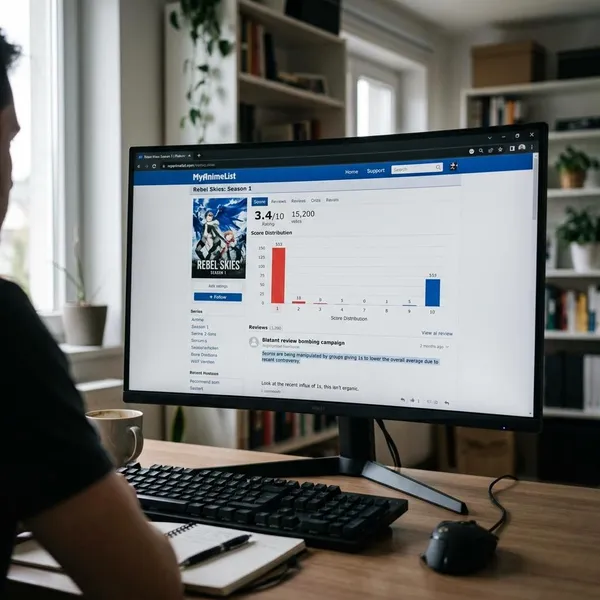
The clearest MAL voting campaigns
MAL score drama is easiest to judge when the rating movement has visible coordination, unusual timing, or a public campaign around it. That matters because not every harsh score is fake. A viewer can honestly dislike a show, but a wave of extreme ratings aimed at moving the leaderboard is a different thing.
Interspecies Reviewers was pushed up by fans
Interspecies Reviewers is usually discussed as score boosting rather than low-score review bombing, but it belongs in the same conversation. After controversy around its distribution and removal from some platforms, supporters openly encouraged high ratings as a statement, not just as ordinary audience feedback.
That is why the case still gets cited. The issue was not simply that people liked the show; it was that the MAL score became part of a public culture-war push. When a rating campaign is that visible, the ranking starts reflecting mobilization as much as reception.
Chihayafuru 3 was targeted with low scores
Chihayafuru 3 is one of the stronger examples of suspected low-score targeting. Fans noticed extreme ratings arriving around the time the series was highly placed, which made the drop look connected to leaderboard pressure rather than a sudden collapse in viewer opinion.
The useful distinction is timing plus shape. A respected niche anime getting mixed scores is normal; a fast cluster of 1/10 ratings during a ranking fight looks more suspicious. That does not prove every low rating was fake, but it explains why this case is treated as more convincing than many newer accusations.
Why newer review bombing claims are harder to prove
Newer MAL controversies are messier because fans now track scores in real time. A small dip can trigger screenshots, accusations, counter-rating, and arguments before the score has had time to settle.
The first thing to check is whether the anime is still airing or fighting for a top position. An airing show with a passionate early voter base is naturally more volatile than an older completed series with hundreds of thousands of ratings. A top-ranked title also attracts people who care more about chart position than the anime itself.
Frieren claims focus on the top-ranking battle
Frieren: Beyond Journey's End has been accused of being review bombed, mostly because users reported sudden 1/10 waves and low-activity profiles while it was competing near the top of MAL. That is a reasonable thing to question, especially when tiny decimal changes decide chart placement.
Still, the public evidence has limits. MAL users can see visible profiles and score distributions, but they cannot confirm duplicate accounts, hidden filtering, or which votes were already discounted. The fairest label is credible suspicion, not fully proven public fact.
Bleach TYBW claims rely on fan-tracked score shifts
Bleach: Thousand-Year Blood War sits in a different kind of risk zone: a huge legacy franchise with loyal fans, old critics, and rival fandoms watching the score closely. That makes score movement noisy even before manipulation is considered.
- Fan screenshots can show suspicious timing, but not MAL's internal filtering.
- Casual viewers may rate less generously once hype cools down.
- Rival fandom behavior can amplify ordinary score movement into a public score war.
So the claim is plausible, but it is mostly built from outside tracking rather than confirmed moderation evidence.
Attack on Titan claims overlap with ending backlash
Attack on Titan is hard to classify because real backlash around the ending overlaps with possible tactical voting. A large finale can produce honest 1/10 ratings from disappointed viewers, even if that looks similar to a bombing wave on the surface.
This is a good example of when not to jump too fast. If a show has a divisive ending, political fandom arguments, and rival communities all active at once, the score may contain both genuine anger and bad-faith voting. Calling the whole movement fake would be too simple.

What review bombing looks like on MAL
Review bombing on MAL usually looks like a sudden attempt to push a score up or down with extreme ratings. The strongest warning signs are not just low scores, but low scores arriving in a suspicious pattern.
If you are checking a controversial MAL score, use this order: look at the timing first, then the rating distribution, then the account histories, then wait to see whether the score stabilizes. That is more reliable than reacting to one screenshot.
Coordinated waves of extreme scores
A normal audience usually creates a spread of ratings. A suspected campaign often creates a sharp burst of 1/10 or 10/10 scores in a short window, especially right after a title reaches number one, passes a rival, or becomes a social media argument.
New accounts with narrow rating histories
New or nearly empty accounts become suspicious when they rate one anime extremely low and a rival extremely high. One account like that means little; dozens appearing around the same time are harder to dismiss.
Rival titles moving during the same ranking fight
Fandoms often suspect bombing when one anime drops while a direct rival rises. Sometimes that suspicion is fair, but it can also become self-fulfilling: fans see a dip, call it sabotage, then start counter-rating to "fix" the chart.
- Low-risk sign: a small score change during normal weekly airing.
- Higher-risk sign: a sudden extreme-score burst after a rank milestone.
- Strongest concern: matching movement between rival titles plus many thin accounts.
Score changes that reverse after filtering
A suspicious drop that later rebounds is one clue that MAL's filters may have reduced the impact of low-trust votes. It does not prove exactly what happened, but it does mean the first visible score was not necessarily the final signal.
For seasonal anime, waiting a few days is often the smartest move. Immediate reactions capture drama; later movement tells you whether the change actually lasted.
How MAL limits score manipulation
MAL has said it uses systems to reduce manipulative ratings, although the exact rules are not public. That secrecy is normal: if every anti-abuse rule were known, people trying to game the rankings could work around it.
The useful reader takeaway is that the visible score is not always a raw, permanent average of every vote submitted. A sudden movement can be real on the page for a while and still lose influence later.
Duplicate-account votes can be excluded
MAL can discount suspicious duplicate-account activity. Regular users cannot verify the detection process from the outside, so the best public clue is often whether a strange score movement settles or reverses after some time.
Brigaded scores can be filtered
Brigading is harder than simple duplicate spam because the voters may be real people. The problem is motivation and timing: if a group rates tactically to win a fandom fight, the score becomes less about honest evaluation.
This is why a completed anime with a large, stable voter base is usually easier to trust than a currently airing title in a heated ranking battle. Bigger samples do not make manipulation impossible, but they make small raids less powerful.
Weighted scores reduce small-sample swings
Weighted scoring helps reduce early volatility, especially when an anime has fewer ratings. A small group of extreme votes can move a new or airing title much more than an older title with a large rating pool.
- Check whether the anime is still airing.
- Look for extreme rating clusters, not just the average score.
- Sample recent profiles for thin or one-sided activity.
- Wait to see whether filtering or more votes stabilize the score.

Conclusion
MAL ratings are useful, but the smartest reading is by confidence level: Interspecies Reviewers and Chihayafuru 3 are the clearest community examples, while Frieren, Bleach TYBW, and Attack on Titan sit in a grayer area. If a score changes overnight, check the pattern before trusting the panic; if the score holds over time with a broad voter base, it is usually a better signal than the first wave of fandom reaction.